The 12-week path
Short recorded lessons and ready-to-use templates for every week.
Australia x Japan x The Globe
For non-technical B2B founders
Without hiring a CTO.
Sell as you build is a 12-week group program for non-technical B2B founders. Get paid before you build, deliver with a simple Founder MVP you own, and grow from there, without spending a fortune on an app nobody asked for.
Free, two pages, two minutes. Find out if you can sell it by hand before you pay anyone to build it.
Free founder tool
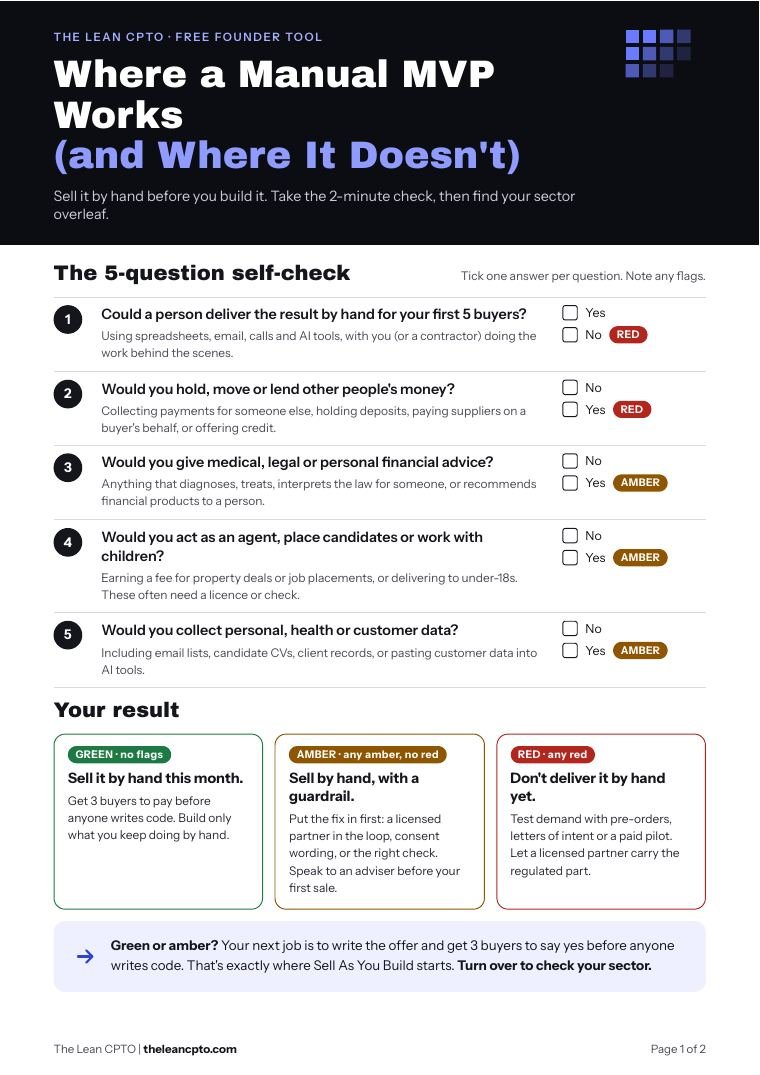
Before you pay anyone to build it, take the Manual MVP Check. Five questions give you a green, amber or red result. Then check your sector for what works by hand, what doesn't, and the red lines to watch.
None of these are tech problems. They're decisions about what to sell, what to build and where to find customers.
The first intake starts Tuesday 3 November, and a new one starts every month after that. Everyone begins at week 1. You move at your own pace, with founders at every stage around you. It takes 4 to 5 hours a week.
Short recorded lessons and ready-to-use templates for every week.
A short lesson, then hot seats where you get help on your exact situation.
You post your conversations, offers and payment asks, so nobody drifts.
Because some sales take longer than 12 weeks.
Founding member price US$1,997 or 3 payments of US$697 for the first 10 founders or until 31 December. Then US$2,997.
Covered by the Week 4 Promise: refine, pivot, start fresh or get your money back. Want it 1:1? Private is US$6,000, 2 places at a time.
Everything that's includedIt also helps me recognise when I am falling into common founder traps or patterns, and redirects or pauses me before I go too far in the wrong direction.
As a founder without a strong technical background, I knew that we needed to introduce advanced IT and AI solutions into our company, but I often felt uncertain about where to start. He guided me from the very beginning.
I got to know what the right MVP looks like.
Start with a live workshop for founders building with AI: keep your MVP costs down, get unstuck at 80%, or check it's safe to sell. From US$47, and your ticket comes off the program if you join within 14 days.
Apply in a few minutes. If it fits, you can join straight away. If it doesn't, we'll tell you why.