12 Lean Product Lessons From 12 Real Case Files
Twelve real product stories, one lesson each, in the order you’d need them if you had twelve weeks to test an AI startup. Then a free game where you can practise them with someone else’s $500k.
The short answer
To test an AI startup idea in twelve weeks, spend the first four proving the problem is real, the next four proving people will use it and pay for it, and the last four deciding what to back and pitching the evidence. Each step has a real product story behind it, from the Palm Pilot’s block of wood to Superhuman’s 40% test. I built a free game, The 12-Week Accelerator, so you can practise all twelve before it’s your own money on the line.
The trailer for The 12-Week Accelerator. Watch it, then play it free.
AI has made building cheap. A demo is an afternoon’s work. A working app is a weekend. That’s great news, and it’s also how businesses end up with fourteen features, a burn rate and no customers.
The lessons below are old. The founders who used them weren’t geniuses with crystal balls. They just found the cheapest way to learn the thing that would kill them, before it killed them.
How do you test an AI startup idea in 12 weeks?
One lesson a week, in this order. The order matters: there’s no point measuring retention for a problem nobody has.
| Week | Lesson | Case file | Do this week |
|---|---|---|---|
| 1 | Test your riskiest assumption first | Palm Pilot’s block of wood | Write down the one belief that kills you if it’s wrong |
| 2 | Trust behaviour over opinions | The Mom Test | Ask five people about the last time the problem happened |
| 3 | Fake it by hand before you automate | Zappos | Deliver the outcome by hand to five customers |
| 4 | Smoke-test demand | Dropbox’s demo video | Put up a demo or page and count deposits |
| 5 | Scope the MVP to one job | Burbn becomes Instagram | Find the one action your best users repeat |
| 6 | Money beats intent | Pebble’s Kickstarter | Ask for a deposit, pre-order or paid pilot |
| 7 | Actionable metrics, not vanity | IMVU and cohorts | Swap one total for a cohort view |
| 8 | Slow down for one-way doors | Humane AI Pin | Mark every big decision one-way or two-way |
| 9 | Pivot on evidence, not panic | Nintendo and the Wii | Book a pivot-or-persevere meeting |
| 10 | Measure product-market fit | Superhuman’s 40% test | Ask the “very disappointed” question |
| 11 | Win a beachhead, then expand | Tesla’s Master Plan | Pick one segment you can win completely |
| 12 | Lead with the outcome | “1,000 songs in your pocket” | Open your pitch with one outcome and one number |
Weeks 1 to 4: is the problem real?
1. Test your riskiest assumption first (the Palm Pilot)
Early nineties. Jeff Hawkins’ team had written the software for the Zoomer, a handheld computer that flopped: too heavy, too slow, too many features. For the next one, before any engineering, Hawkins cut a block of wood to fit his shirt pocket. He carried it for weeks and tapped it with a chopstick whenever someone asked for a meeting.
He was testing one thing: would people carry a device that size every day? The Palm Pilot became one of the fastest-selling computers of its time.
Every startup has one belief that sinks it if it’s wrong. For an AI bike light, it’s whether the battery survives a night shift with the chip running. For an AI agent that chases invoices, it’s whether a business will let software message its own customers about money. Name yours, then find the cheapest fake that tests it: a paper mock, a clickable Figma, a block of wood.
AI makes it cheaper than ever to build the real thing. That makes it more tempting to skip the block of wood, not less.
2. Trust behaviour over opinions (The Mom Test)
No case file here. Just the most useful book on customer interviews: The Mom Test by Rob Fitzpatrick.
People are polite. Ask whether they like your idea and they’ll say yes. Even your mum. Especially your mum.
So ask about their life instead. When did this last happen? What did you do about it? What did it cost you? Past behaviour and money already spent don’t lie. Compliments, and anything that starts with “I would”, are noise.
3. Fake it by hand before you automate (Zappos)
1999. Nick Swinmurn wanted to sell shoes online, and everyone told him nobody buys shoes without trying them on. So he didn’t build a warehouse. He photographed shoes in local shops and posted them online. When an order came in, he went back, bought the pair at full price and posted it.
He lost money on every pair. He also proved people would buy shoes online. That was Zappos, and Amazon bought it in 2009 for about US$1.2 billion.
The customer saw a shoe shop. Behind the curtain it was one bloke and a camera. That’s a Wizard of Oz MVP, and it’s the same idea as the manual MVP. Deliver the outcome by hand to five customers and write down every step you repeat. That list is your backlog.
I see the opposite with AI products all the time. The agent gets automated before anyone has done the job by hand five times.
4. Smoke-test demand before the hard build (Dropbox)
2007. Drew Houston kept forgetting his USB stick, so he started building file sync. Making it work on every kind of computer meant years of hard engineering. Before finishing it, he posted a three-minute demo video aimed at the tech crowd on Digg. The Dropbox beta waitlist went from about 5,000 people to 75,000 overnight.
That’s a smoke test: show the promise and count the hands before the expensive build.
The 2026 version: AI makes the demo an afternoon’s work, so everyone has one. Knowing whether anyone wants it is still the hard part. And a waitlist is the weakest form of the answer. Deposits beat sign-ups.
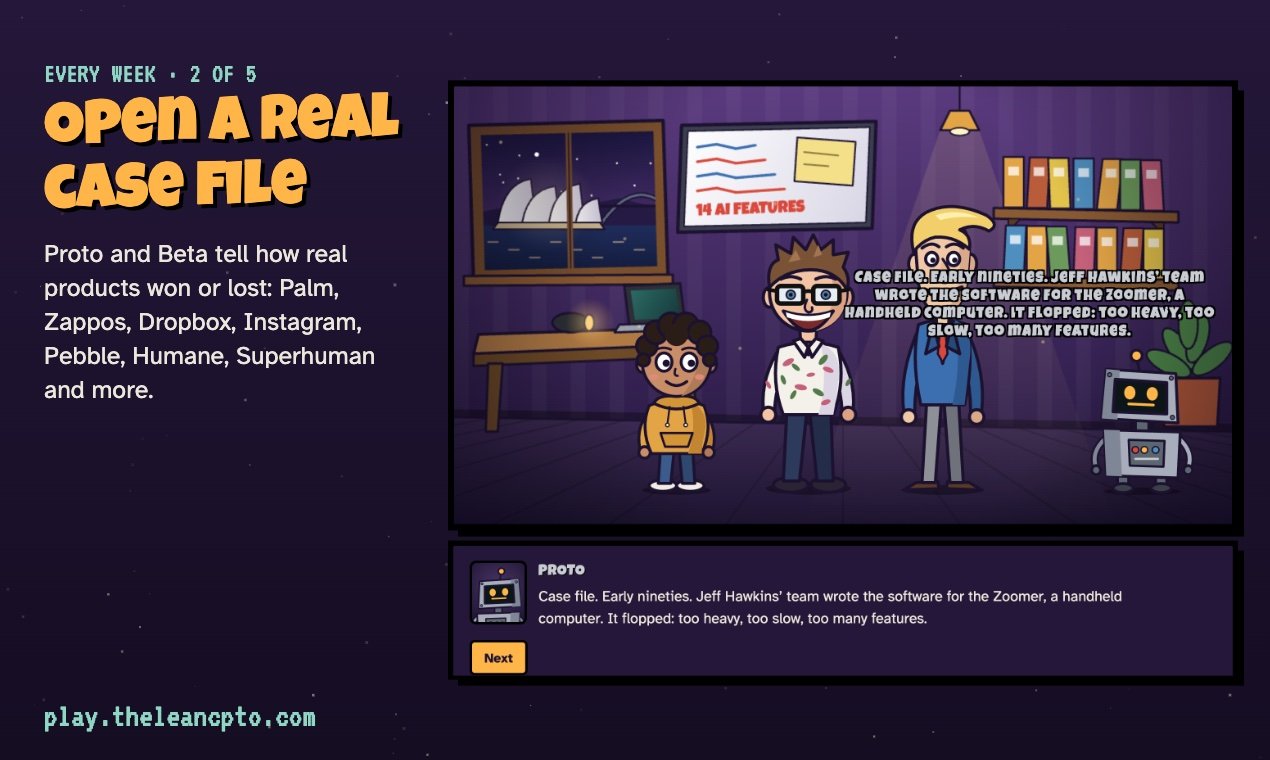
Every week opens with a real case file. Proto tells the hardware stories, Beta the software ones.
Weeks 5 to 8: will they use it and pay?
5. Scope the MVP to one job (Burbn becomes Instagram)
2010. Kevin Systrom and Mike Krieger built Burbn: check-ins, plans, points and photo sharing. Lots of features. Not many users. The data showed people ignored nearly everything except posting photos. So they cut the rest and relaunched it as Instagram. About 25,000 people signed up on the first day.
Find the one action your best users already reach for. Cut or hide everything that doesn’t serve it. Every other feature is inventory you haven’t sold yet. If you’re stuck on what to cut, Build. Delay. Kill. walks through it.
6. Money beats intent (Pebble)
2012. Eric Migicovsky couldn’t raise more money for Pebble, a smartwatch with an e-paper screen. Investors were wary of hardware. So he put it on Kickstarter and asked for US$100,000. Nearly 69,000 backers pledged over US$10 million, before a single production watch existed.
Willingness to pay is measured in money, not adjectives. Deposits, pre-orders, paid pilots, signed letters of intent. “87% said they’d definitely buy” is a compliment. “38 people paid a $20 deposit” is evidence. For B2B, the paid pilot is your pre-order.
7. Actionable metrics, not vanity metrics (IMVU)
Mid-2000s. Eric Ries was CTO at IMVU, a 3D avatar chat startup. Total sign-ups climbed every month and the team felt great. Then they tracked each week’s new users separately, as cohorts. Their product changes weren’t moving how many people stayed or paid. The growth chart had hidden it.
Ries later wrote The Lean Startup. Totals go up and to the right almost no matter what, like my weight between Christmas and New Year. Cohorts tell you whether the product is getting better.
If a number can’t change a decision, stop reporting it. Replace one total on your dashboard with this: of the people who started in week N, how many did the core action again in week N+1?
8. Slow down for one-way doors (Humane AI Pin)
2024. Humane launched the AI Pin: no screen, a laser projector onto your palm, ex-Apple designers, a beautiful launch video. It had raised over US$230 million. It shipped at US$699 plus US$24 a month. Reviewers found it slow, hot and short on battery. Within a year HP bought the assets for US$116 million and the pins stopped working.
Jeff Bezos calls these one-way doors: decisions you can’t walk back through. Factory tooling. Minimum orders. Exclusive deals. A price on a box in a shop. Move fast through two-way doors. Slow right down for one-way doors, and prove the job first.
This isn’t a dunk on the team. Plenty of smart people worked there. That’s the point. Smart people walk through one-way doors at full speed all the time.
Weeks 9 to 12: what do you back, and how do you pitch it?
9. Pivot on evidence, not panic (Nintendo and the Wii)
Nintendo was founded in 1889 to make playing cards. It tried a taxi company and instant rice before toys, and then video games, stuck. In 2006, behind its rivals on graphics power, it stopped chasing hardcore gamers. The Wii went after people who didn’t play games at all: parents, grandparents, retirement homes. It sold over 100 million units.
Pivot or persevere is a decision you make on evidence, on a schedule, not at 2am after a bad week. Keep the vision, change the strategy, and look for the customer who is already pulling. Book the meeting every six weeks and bring the evidence.
10. Measure product-market fit (Superhuman)
2017. Rahul Vohra had spent two years building Superhuman, an email app, without a public launch. He wanted a number, not a gut feeling. He asked users: “How would you feel if you could no longer use Superhuman?” Only 22% said very disappointed. Sean Ellis’ benchmark for product-market fit is 40%. He studied the users who said very disappointed, built for them, and the number climbed to 58%.
For AI products this matters even more. Everyone gets a wow demo. Whether people would be gutted to lose it is the real test.
11. Win a beachhead, then expand (Tesla’s Master Plan)
In 2006 Tesla published its “Secret Master Plan”: build a sports car, use that money to build an affordable car, then an even more affordable one. People laughed at an electric car for rich people. That was the point: a small market that wanted it badly and forgave a lot.
Start narrow. Win somebody completely. Then go wide. Write down which segment your beachhead unlocks next, so “narrow” doesn’t turn into “small forever”.
12. Lead with the outcome and the evidence (the iPod)
October 2001. Every MP3 player advertised storage, file formats and battery hours. The first iPod had a 5 GB hard drive. Apple didn’t lead with that. It launched with “1,000 songs in your pocket.”
Your pitch is the same test. Investors have heard every vision deck. Open with one customer outcome and one number that proves people want it. The market size can wait for slide five.
Why practise this in a game?
Reading twelve lessons is easy. Using them when your co-founder is shouting about features and the factory wants a deposit by Friday is harder. So I built The 12-Week Accelerator.
You get $500k and twelve weeks to take one of four AI startups to Demo Day:
- Glow, a bike light that spots cars coming
- Pantry, snap your fridge and get three dinners
- Ledgerbird, an AI agent that chases invoices for tradies
- Nightshift, a floor-scrubbing robot you rent by the month
Each week you plan a sprint, open the case file from that week’s lesson and make one big call. Every call costs cash, buys evidence, or both. Customer interviews rule out a bad option before you choose. Curveballs turn up uninvited, like a giant announcing your feature on a Monday morning.
Your co-founder Rex wants fourteen features. Vale the investor wants evidence. You can’t give both. I’m in there as myself, telling you straight when a call cost you.
To earn a term sheet you need three of four milestones (problem validated, solution validated, willingness to pay, a retention signal), solid evidence and money still in the bank. You’re scored out of 1000 on outcome, milestones, evidence, cash left and lean calls. Shipping lots of features isn’t on the list. Rex thinks this is unfair.
There’s a weekly challenge too: same startup and same curveballs for everyone, one leaderboard. The prize is the top spot and nothing else, because I run a lean operation.
It’s free, there’s no sign-up, and a run takes about 25 minutes.
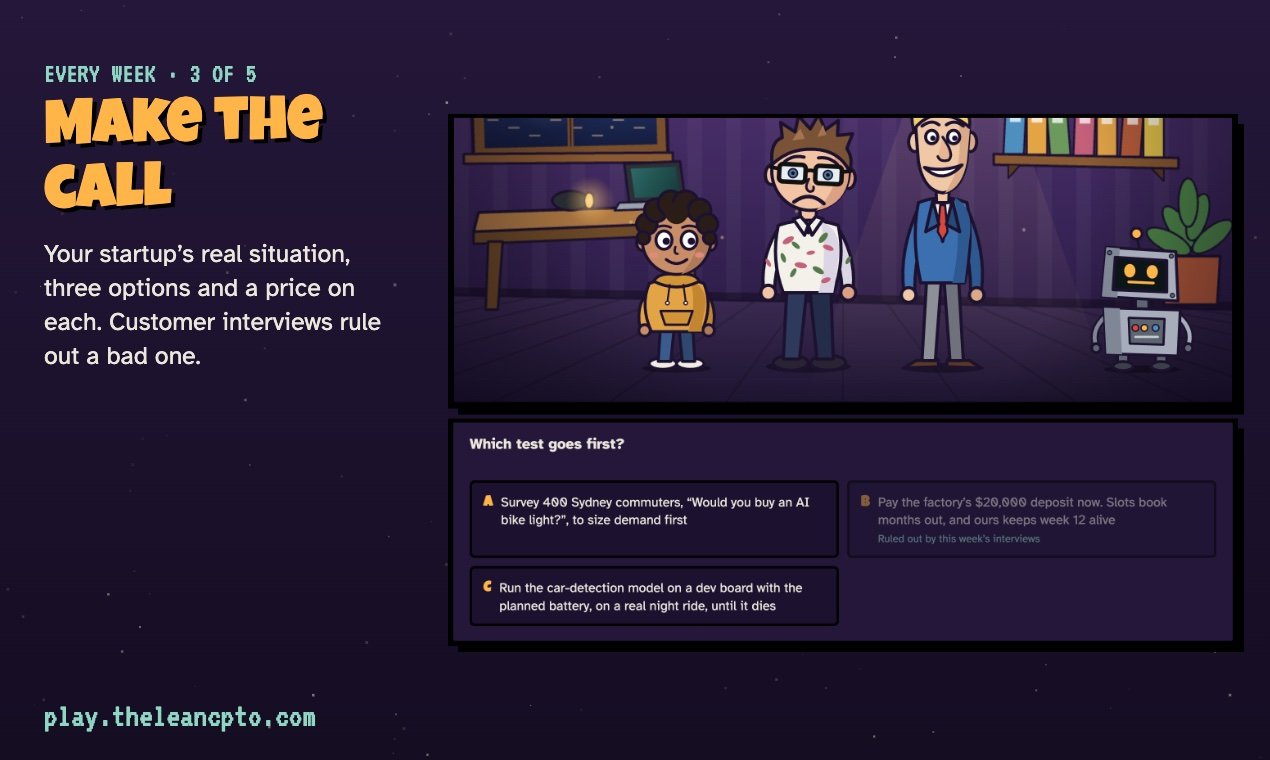
Three options, a price on each. Do your interviews and one bad option is ruled out for you.
Practise the twelve lessons with someone else’s money
The 12-Week Accelerator is free, takes about 25 minutes and needs no sign-up. Post your score and I’ll tell you what I’d have done differently.
Play free
Join the Pro waitlist
Want to run it on your own startup? Pro (coming soon) puts your real idea through the same twelve weeks and emails you a lean plan. Founding members get it for US$29.
Frequently asked questions
What are the core lean product lessons?
Test your riskiest assumption first, trust behaviour over opinions, fake it by hand before you automate, smoke-test demand, scope to one job, ask for money, track cohorts not totals, slow down for one-way doors, pivot on evidence, measure product-market fit, win a beachhead, and lead your pitch with the outcome.
How do you test a startup idea quickly and cheaply?
Name the one assumption that kills the idea if it’s wrong, then test it with the cheapest fake you can: a mock-up, a demo video, a landing page with a deposit, or the service delivered by hand. Ask about past behaviour, not opinions, and count money, not compliments.
What is the 40% product-market fit test?
Ask active users how they’d feel if they could no longer use your product. If at least 40% say “very disappointed”, you likely have product-market fit. Sean Ellis set the benchmark, and Superhuman used it to go from 22% to 58%.
What is a one-way door decision?
A decision you can’t easily reverse, such as factory tooling, a minimum order, an exclusive deal or a public price. Jeff Bezos coined the term. Move fast on two-way doors and slow down on one-way doors until you have evidence.
Is The 12-Week Accelerator free?
Yes. It’s free to play with no sign-up, with a weekly challenge and leaderboard. A Pro version that runs on your own startup is coming, with a founding price of US$29 for people on the waitlist.
Related guides
- The Manual MVP: get paid before you write code
- The Paid Pilot playbook
- Build. Delay. Kill. How to decide what goes in your MVP
- Sell It By Hand: how to sell a startup MVP before you code
Sources
- Rob Fitzpatrick: The Mom Test
- Eric Ries: The Lean Startup
- First Round Review: How Superhuman built an engine to find product/market fit
- Pebble: E-Paper Watch for iPhone and Android (Kickstarter, 2012)
- Tesla: The Secret Tesla Motors Master Plan (2006)
Case file figures are as commonly reported and rounded. General information only, not financial or investment advice.
About the author
Matt Ainsworth is the founder of The Lean CPTO. He has spent 20+ years across product, tech, sales, marketing and comms in Australia and nearly a decade in Japan, and has mentored founders for more than 10 years. He builds with Claude every day.